KNOW WHERE TO BREAK THE LINE.

SEE HOW MUCH YOU CAN DO WITH THE WORDS YOU ALREADY HAVE.

Learn how changing a line break can give an ordinary phrase more feeling, bring attention to an image, or change the rhythm when you read aloud. You can also use the lines leading into your ending to give it more of the feeling you’ve been building.

I’ll take what I know from more than 20 years of writing and teaching poetry and show you how to use it on a poem of your own—so you can hear the difference your choices make and understand why they work.

WHERE TO BREAK THE LINE

A 90-minute recorded poetry course with Dr. Samuel Gilpin.

$37 · IMMEDIATE ACCESS

WHERE TO BREAK THE LINE · $37

WHERE SHOULD THIS LINE END?

You break where a sentence ends. Where you take a breath. Where the line looks long enough.

Then you move a few words around—and you’re unsure whether you’ve made the poem better or just made it look different.

When I started writing poetry, I usually ended a line where an idea ended, or where I had some part of a sentence. That was basically it. I didn’t realize how much else I could do.

Maybe that’s where you are. You’ve written something, you’ve put it into lines, and now you’re wondering whether it’s just prose broken up on the page.

There’s a lot you can do with those breaks. You can hold something back for a moment. Give a detail more attention. Change how the poem sounds without changing what it says.

And once you can see what’s happening, you have a way to decide where you want the line to end.

WE HAVEN’T CHANGED A SINGLE WORD.

Take this sentence:

I kept the letter because throwing it away would have admitted that the person who wrote it was gone.

Now let’s put in some line breaks:

I kept the letter because throwing it away would have admitted that the person who wrote it was gone.

Each line gives you a phrase before you move into the next one. Now look at this:

I kept the letter because throwing it away would have admitted that the person who wrote it was gone.

“I kept the letter because”—because why? You’re waiting for something. Then you get to “was,” and you still have to go to the next line to complete the thought.

And there’s “gone,” sitting by itself.

We haven’t changed a single word. But we’ve changed how you move through the sentence and how much attention that last word receives.

Am I saying you should end every poem on one word? No. I’m showing you something you can use when you want that kind of emphasis.

GET MORE OUT OF THE WORDS YOU’VE ALREADY WRITTEN.

Here’s what you’ll learn to do in your own writing:

  • Get more feeling out of the words you’ve already written. Before you decide a passage needs more beautiful language, see what happens when you change how those words are arranged.
  • Give the reader a reason to keep going. Hold a thought open, delay something for a moment, or let the next line change what they thought you were saying.
  • Hear what needs attention when you read aloud. When a phrase sounds awkward or a word gets more emphasis than you want, you’ll have a way to work on it.
  • Give an image room to be noticed. If there’s a detail you care about and it’s getting lost in the sentence, you can change how the reader encounters it.
  • Work toward the ending from earlier in the poem. See how the lines before it can give the final words more force, rather than putting all that pressure on finding a great last line.
  • Choose the version you want to keep—and understand why. You can compare two arrangements, hear what each one does, and decide what works for this particular poem.

You might move a break and like it more. You might move it back. Either way, you’ll have a better idea of what you’re doing and something you can use the next time you revise.

LEARN TO NOTICE WHAT AN EXPERIENCED POET NOTICES.
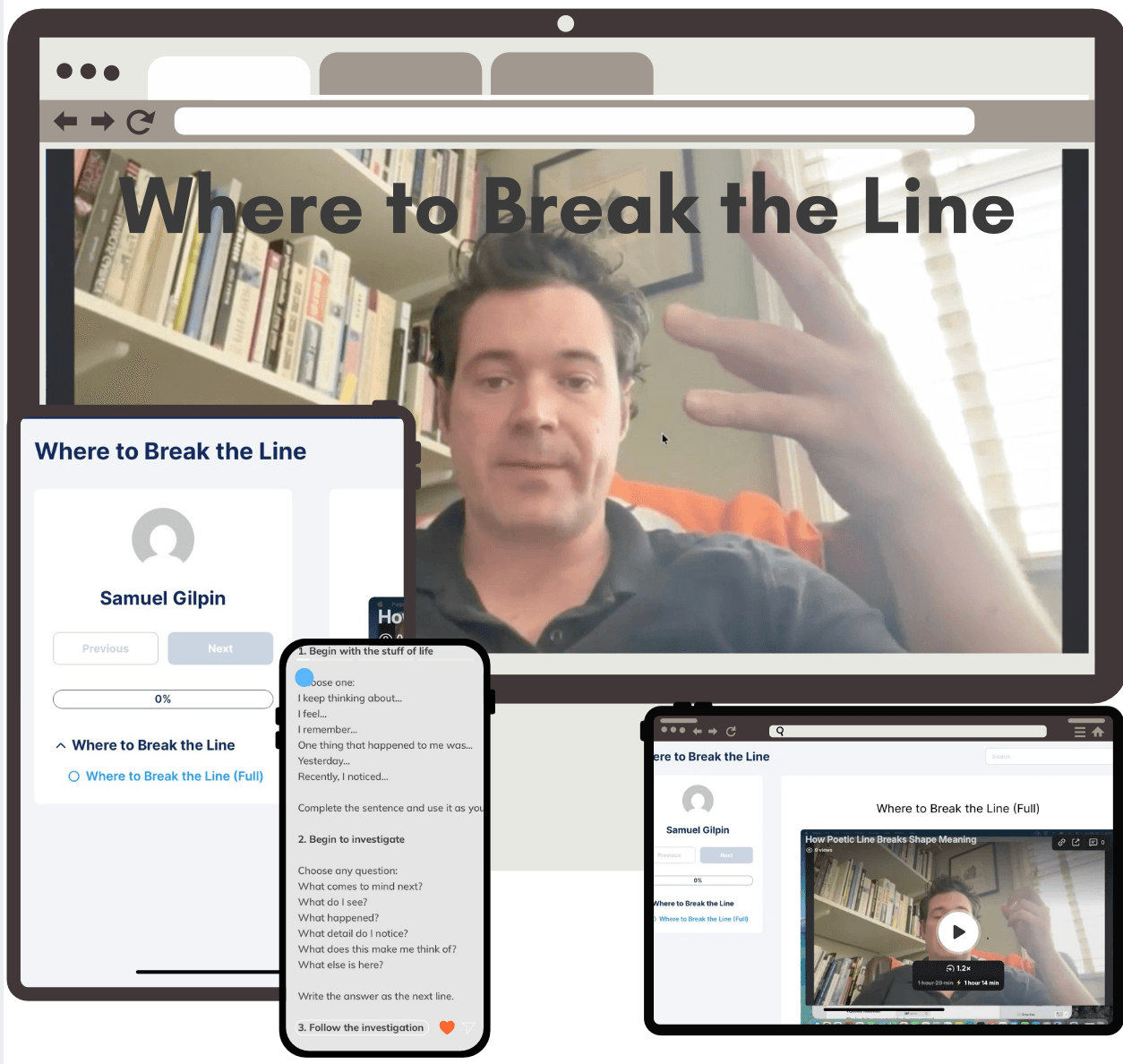
Where to Break the Line course shown on desktop, tablet, and phone.

In this 90-minute course, I work through examples and my own poems, changing the line breaks and reading the different versions aloud.

I’ll show you why a phrase sounds awkward to me, where a break puts emphasis on a word I don’t want emphasized, and how another arrangement changes what I hear. Then we’ll compare the versions so you can hear it too.

Over time, you develop an ear for these things. I’ll explain what I’m noticing and why it matters, so you know what to look for in your own poem.

We’ll look at meaning, movement, sound, and attention. You’ll leave with four questions you can come back to when you’re revising and don’t know where a line should end.

Bring a poem you’re working on. It can be rough. You just need something on the page that you can try this with.

THE WORKSHOP COMPANION

You’ll also get an 11-page companion with the main ideas and examples from the workshop, including the four questions you can return to when you’re revising. Keep it nearby when you want to revisit something without finding it in the video.

90-MINUTE RECORDED COURSE + WORKSHOP COMPANION · $37 · IMMEDIATE ACCESS

WHERE TO BREAK THE LINE · $37

A FEW THINGS BEFORE WE BEGIN.

DO I NEED TO KNOW POETIC FORMS OR TECHNICAL TERMS?

No. If you’ve written a poem and wondered where the lines should end, you have somewhere to begin.

I’ll explain the ideas as we go, and you’ll see them happening in the examples.

WILL THIS TELL ME THE CORRECT PLACE TO BREAK EVERY LINE?

There isn’t one correct place that works for every poem.

You can arrange the same words several ways and get something different from each one. The point is to understand those differences so you can decide what you want to do.

HOW IS THIS DIFFERENT FROM YOUR REVISION WORKSHOP?

The revision workshop looks at the poem as a whole and the different things you can work on when you return to a draft.

Here, we spend about 90 minutes on the line break itself. We have time to look closely at what happens when you move it, read the poem differently, and try another arrangement.

WHO’S TEACHING IT?

I’m Dr. Samuel Gilpin. I’ve been writing poetry for more than 20 years. I have a PhD in English, an MFA in Writing, and I’m a published poet, a creative writing instructor, and a former editor.

HEAR THE DIFFERENCE IN YOUR POEM. KNOW HOW YOU MADE IT HAPPEN.

There’s something satisfying about changing a poem, reading it aloud, and hearing a part that finally sounds right.

Maybe an image has more room. Maybe the sentence moves the way you want it to. Maybe you’ve found a way to give the ending more of the feeling that brought you to the poem in the first place.

And you know what you changed to get there.

That’s an understanding you can take into the next poem, and the one after that. When you come back to another draft, you’ll know what to listen for and have a way to decide where the lines should end.

Get immediate access to Where to Break the Line for $37.

WHERE TO BREAK THE LINE · $37

YOUR DETAILS

ORDER SUMMARY

PAYMENT METHOD